| This site was founded by the late John Skakel. Contact us HERE
Cemeteries Office Staff have asked that users NOT contact them with questions directly. Cemetery Preservation An introductionStone Identification
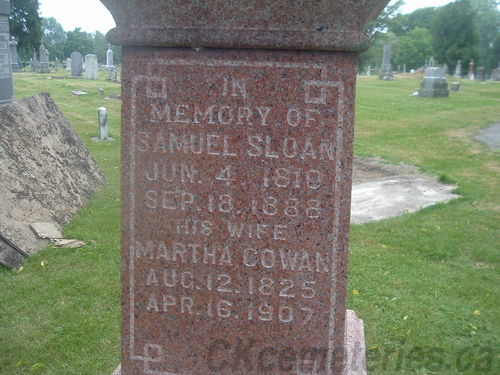
Typical red granite stone
Part of spire stone. |
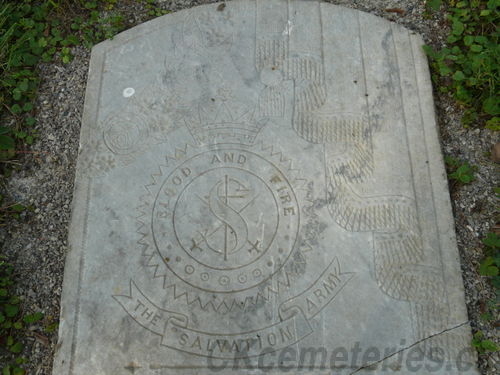
Unusual stone type we are still
trying to identify.
Possibly a type of slate used? |
Learning to deal with Types of Monuments
Here is a scenario. We mention and you read in books that you should not use epoxy on certain stones as it is not water permeable. Or that you can use premix putty like compounds on some stones but not on others. Yet none of us are experts. How can we tell an unpolished marble stone from a sand stone monument for instance.
Always remember. Keep things simple. Here is what I mean.
Generally in our area at least and I expect most there is only one stone type that is NOT water permeable. And that stone is granite and is extremely easy to identify. Also, you should always try to avoid a stone contacting cement. And cement is relatively easy to identify in larger amounts at least.
So, if you get to know granite, you have got it made for most applications. If it is granite you can use premix putty like compounds. If it is not granite then you should not. If it is not granite you don't need to know if it is sandstone or slate or unpolished marble for instance. Because all of those compounds are treated exactly the same.
Granite is of course easy to identify. Think of almost all modern stones. White, black, red, gray stone with that very distinct marble like pattern in them. And extremely hard rock. Then just remember that granite is not water permeable. So you can use products like latex or silicone next to it. I always hate to see silicone. But it is actually ok to use on them. On the other hand if it is not granite it is not ok to use those. Then you use the Limestone Mortar type compounds to allow water and salts to move through the stone, etc.
Lastly, you may hear people saying "I've used Epoxy for twenty years and I see no damage from it whatsoever." That is probably indeed true. It does take substantial times for damage to show from what we can learn. When it does begin to show it will show up as small rounded edges on the stones corners of the pieces put together.
With time you will get to know stone types.
Granite. Many colours and used in modern stones with the marble like pattern in it
Polished marble. You often see it in construction. Very smooth. White with marble like pattern of different type from above.
Unpolished marble. One very distinct characteristic is that if you scratch it by mistake it will be white. You can wash stones of this material with a power washer and they will look beautiful. But unfortunately if this is done it can shorten their life time and it will not last.
Sandstone. Often a "Sandy colour", but colours can very. This is the material that our bases that we find are made out of.
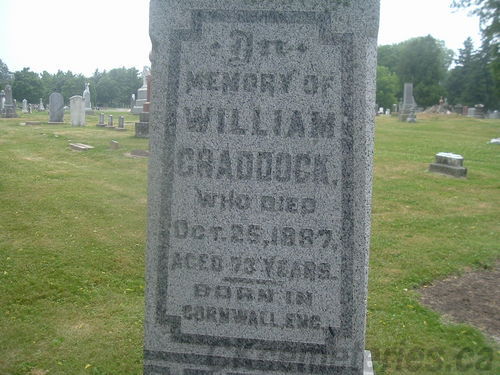
Typical gray granite stone |

Unpolished Marble Stones that were power washed
Doing that makes them look perfect but can
cause severe damage for their life.
Note their blinding white colour.
Photo by John Skakel
|
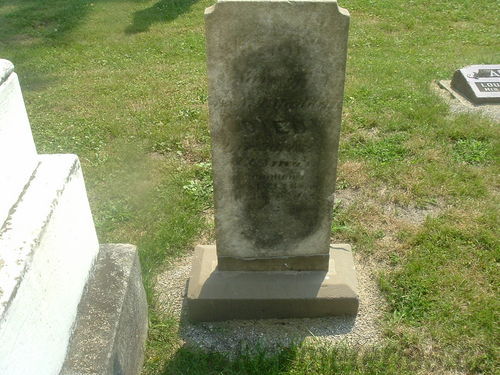
Unpolished Marble that has not been cleaned. |
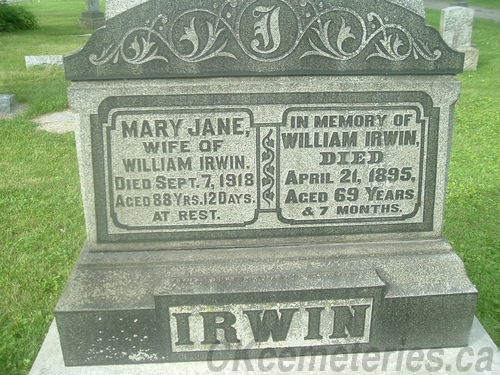
Huge black granite stone. |
Stone Identification
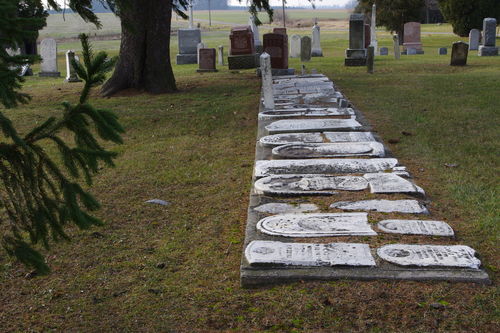
Back in the 50's to 80's stones
were often placed in cement slabs.
Research has now found that causes damage
to them due to use of incompatible
materials. It of course also loses
the original location of all graves.
Photo by J Skakel |
When to move stones and when not to move them.
We are hoping that you looked at this title and said to yourself "Is this guy moving stones? Is he crazy?" Basically you NEVER, but NEVER move a stone with the possible exception of foot stones. We have moved two stones a few inches as they were getting beaten to death with automobiles driving over them. Too close to the road. They were not where they can been seen and people were even parking on them. IF it is a case of move a stone 20 cm to protect it from cars you might think about it. But otherwise you NEVER move a stone. NEVER place them all in a straight line. NEVER move them to cut the lawn around them. Just imagine how far a stone like that can "Walk" if you move it each time that you cut the lawn. You NEVER move a stone because it would look better in line with the one next door. The one exception as noted MIGHT be foot stones. These stones are no longer really necessary to mark the feet of the individual interred there. So, you might decide to move them closer to the head stone, etc. The 100% exception to this of course is if the head stone is missing. Then, you would NEVER move the foot stone.
Inserting stones into cement slabs and brick walls.
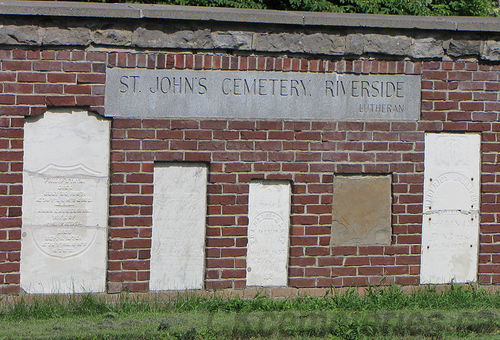
Snes saved in Brick Wall at Chrysler Farm
When St Lawrence Seaway flooded cemeteries.
Use of brick here helping to limit
The damages by Salts caused by Mortarto |
These were techniques used around thirty years ago, but there are inherent problems with doing these things. IF the stones are well exposed to rain it is not quite as bad as the rain will wash the salts off of them. But, if you put a stone into a wall with a cement cap for instance that stops the rain it can get VERY serverly damaged in a relatively short time. The rule of thumb is that you never place a stone next to cement for any reason. Also, if you move those stones to one spot and put them into a long cement wall or slab, you no longer know where that person is buried. That stone is marking their grave. It is in truth like a plot of land owned by them and you are robbing them of that stone. Always leave a stone where it is. Never put it into any type of cement. And never place all stones in a line, etc. Always treat that plot with respect as that ground is owned forever by the people below. If you remove a stone from it you are removing a piece of history. You are removing a part of that person below. And you have absolutely no right to do that. If the stone cannot for some reason be preserved where it is then just leave it for nature to take it's course.
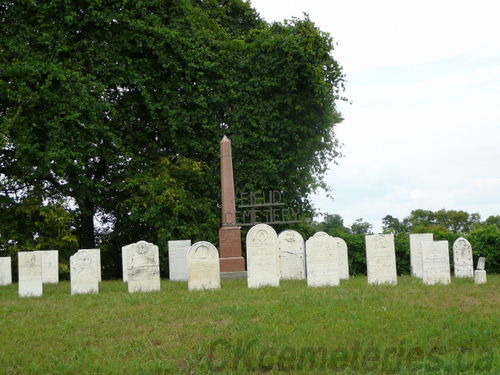
The Field Cemetery. Note how stones
have all been moved into a row.
Now we have no idea where
individual graves were originally located.
A mistake we should avoid in this day and age.
Photo by T Nigh |
Stones Moving on their Own
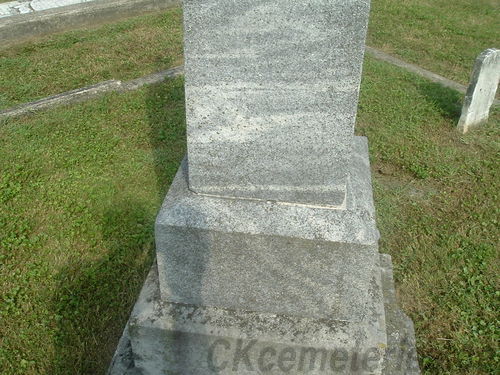
Note how this stone's spire has shifted
to the left on it's base.
Humans could not have pushed
something that is that heavy.
Photo by John Skakel |
Why some Very Heavy Stones Inexplicably Move on their Bases.
You take a walk through your favorite cemetery. You see a huge spire stone that weighs probably close to a tonne on top. Possibly almost a tonne down below. And between those two joints that are rock on rock you see that the stone seems to have moved. You grab the top stone and, as expected, there is no way you can move it. However, when you look at it the stone is not centered. It has moved. How could it move?
We are told that it is possible for ice to accumulate in the middle in such stones. Then, a very high wind can come along and they can actually slide slightly on the ice. Seems like theory that would never happen doesn't it. Yet we all know that it does. We have all seen it.
You might be interested to know that cemetery folks used ice to their advantage. Imagine you put bands around a stone top to bottom on each side to lift it. You set the stone down though and the band is sandwiched between the stone and the base. So how did they used to get those out? Very simple. A few strategically placed pie plates size chunks of ice and they were away. Ice would all melt at the same rate, letting the stone drop evenly and safely.
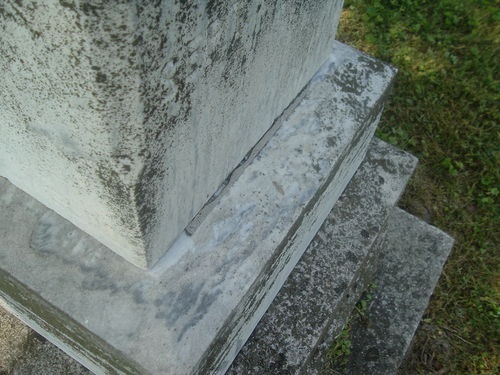
You can see how this huge stone spire
has shifted left.
Too heavy again for human contact to push
Photo by John Skakel |
|