| This site was founded by the late John Skakel. Contact us HERE
Cemeteries Office Staff have asked that users NOT contact them with questions directly. Some History of The Phillips Cemetery
With Thanks to Wayne Phillips
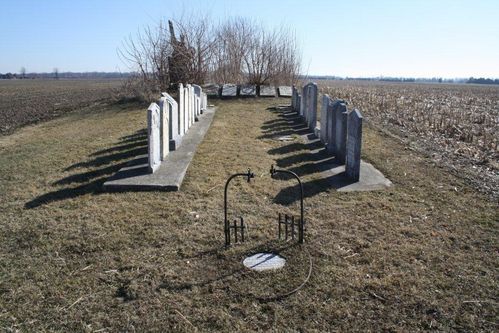
The Phillips Cemetery |
Phillips Cemetery Address:
+42° 33' 52.50", -82° 5' 38.46"
Lot 5 Con 4
Wabash Road
From the booklet "SACRED SPACE: A History of Wabash United Church"
Page 10 and 11
METHODIST EPISCOPAL CHURCHES--4th Concession and Thorncliffe
In the spring of 1870, a group of English settlers established a Methodist Episcopal church on the 4th Concession, less than a mile from the Wesleyans on the corner. The Methodist Episcopal Church was built on the land settled by George Phillips, (Lot 5 Conc. 4). The trustees were Marshall Ney Phillips, Timothy Burwell and John Kelly. It was a frame building, lath and plaster on the inside, of a suitable size--about 24 x 40 feet--for its one chain (66 feet) square lot. Associated with this church on the Phillips farm was the burial ground (Phillips Cemetery) which now occupies the wooded knoll on the south side of the 4th concession not far from the original site of the church.
A second Methodist Episcopal church was established in 1878 at the end of the 4th Concession in the community of Thorncliffe. The trustees of this congregation were Austin Turrill, John Dennison, Leonard Marsh, William Deline and Jesse Rendell. The concentration of churches--three in the space of two miles--from one end of the present Wabash Line to the other made this one of the most thoroughly "churched" areas of the county even by 1870s standards.
Even as these Methodist Episcopal congregations were setting up their houses of worship, national leaders of the Methodist Episcopal--known for its more conservative theology and for the warmth of it’s preaching--and the Wesleyan Methodist Churches debated the question of church union. They finalized the terms of the Methodist Union, which joined Wesleyan and Episcopal Methodist in a national church in 1884. Many of the families from the Methodist Episcopal Church on the 4th concession joined with the Wesleyans in the corner.
The Methodist Episcopal Church building was subsequently used moved and used as a barn on the Phillips farm. The church at Thorncliffe was used for some time by Free Methodist, who eventually moved the building to the hamlet of Wabash where it stands today.
Thamesville Herald January 6 1899 (Wabash)
Mr. Phillips who had been sick the past month, passed peacefully away on Tuesday December 27th. The cause of his death was dropsy. The funeral took place on Thursday afternoon, the service being conducted in the old church by the Rev. Mr. Wilson, assisted by Rev'ds Pickard and LaFleur.
The service was conducted in the church which he himself built, and the remains in the cemetery on his own place. The funeral was the largest ever seen in Wabash, and to those whom his death has plunged into grief we tender respectful sympathy.
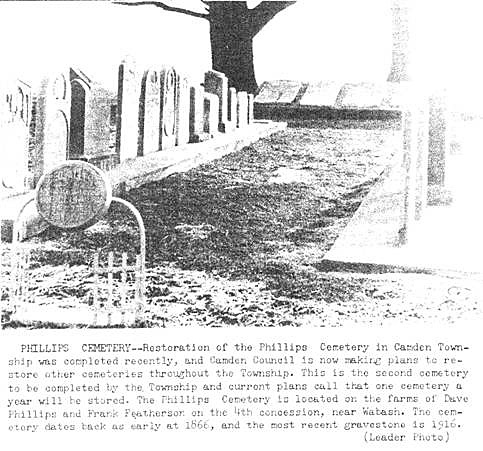
Front Page “North Kent Leader” Vol 1, Issue 17, Thursday, January 6, 1966 |
(Possibly the last Burial in the Phillips Cemetery was Catherine (Sells) Kelley, 7th Oct. 1924.)
Morley Laverne Phillips and Bernice Leona (Kelly) Phillips were instrumental in having the old Phillips Cemetery restored, when the county started to fix up old abandoned cemeteries. Morley and Bernice approached them to include the old Phillips Cemetery on Wabash Line. The cemetery was on the old family farm started by Morley and Bernice’s, great and 2nd great grandfather, George Rex Phillips.
The Phillips Cemetery sign was made in 1966 by Arthur Neaves, brother-in-law of Bernice Phillips.
Thamesville Herald January 9, 1947
A short History of the Wabash Vicinity
By Mrs. John Liberty
-excerpt-
...The first church that was built in this district was the Episcopal Methodist church. It was built on the farm of a pioneer resident George Phillips on the Wabash road. The first ministers were called circuit riders as they came on horse back to the church each Sunday. This church was moved many years ago a short distance from where it was built and is now being used for a barn. Behind where the church first stood and nestled among the trees and shrubs is the old Phillips cemetery where rest many of the old pioneers of the Wabash community.
____________________
From Wayne Phillips...
Just about everyone in this cemetery are somehow related. It started pretty much as a family cemetery on my 2nd great grandfathers (George Rex Phillips) farm, behind the Methodist church that he built there. |